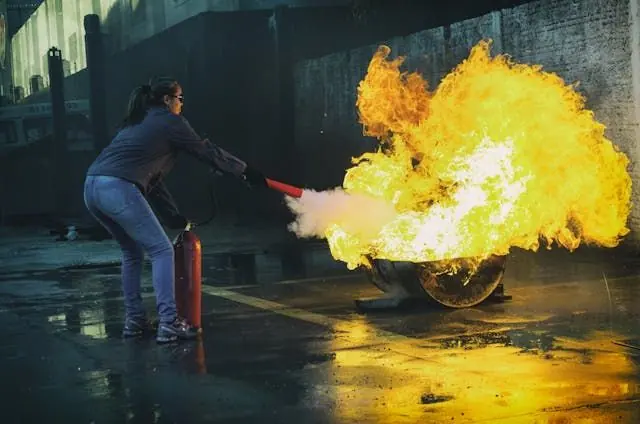
A fire extinguisher that does not work when a fire breaks out is worse than none at all. That is exactly why the law requires regular checks and inspections to verify that the extinguisher will actually do its job. Find out how often fire extinguishers are checked, what an inspection includes and what obligations this means for companies.
What a fire extinguisher inspection is and why it is mandatory
A fire extinguisher inspection is a professional check that verifies its functionality, pressure and overall technical condition. The obligation to check extinguishers regularly is laid down in the Czech Decree No. 246/2001 Coll. on fire prevention, regardless of the size of the company or the type of operation.
A neglected or non-functional fire extinguisher is a risk on two levels. In a fire, it may not work in time, and during an inspection by the Fire and Rescue Service or an insurer’s investigation, it becomes grounds for a penalty or a reduced insurance payout. Regular inspection therefore protects both property and the company’s legal certainty.
Checks, maintenance and repairs of fire extinguishers may only be carried out by people who meet the requirements set by law, the relevant standards and the manufacturer’s documentation for the specific extinguisher.
How often a fire extinguisher must be checked
An operability check of a fire extinguisher is carried out at least once a year, unless the manufacturer’s documentation specifies a shorter interval. This applies to all types of portable fire extinguishers without exception.
Besides the annual check, the law also requires a periodic test – a more thorough check of the technical condition of the cylinder and valve. Its interval depends on the type of extinguishing agent:
- Water and foam fire extinguishers: periodic test once every three years
- Powder, CO₂ and other fire extinguishers: periodic test once every five years
We recommend keeping the dates of both types of check in one place, ideally in a digital register, so that no deadline slips by unnoticed.
What an operability check includes
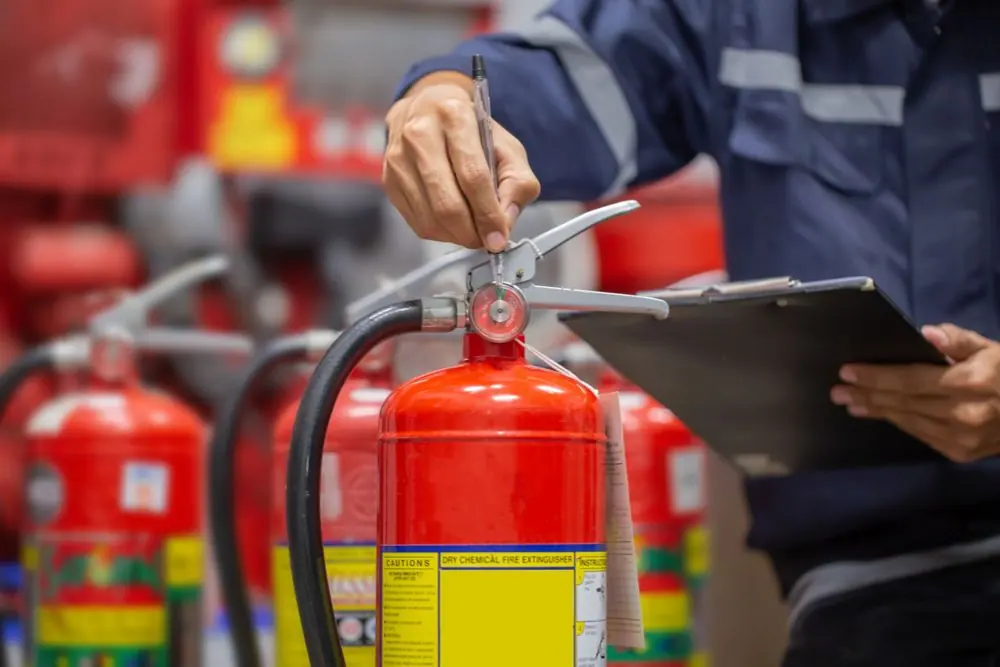
The annual operability check includes a visual inspection of the extinguisher, checking the pressure, checking the seal and making sure the label is legible. The technician also checks that the extinguisher is in the right place and that nothing prevents easy access to it.
The periodic test is a more thorough check of the extinguisher’s technical condition. Among other things, it includes checking the cylinder and its interior, its strength and tightness, and the relevant parts of the fittings and valves.
After the check, the owner receives proof of the inspection, and the extinguisher is fitted with a new inspection label showing the date of the check and the date of the next one. Without this proof, the extinguisher’s operability cannot be demonstrated.
When an immediate inspection is necessary
An extraordinary check is necessary immediately after the extinguisher has been used or whenever there is any doubt about its operability, for example after a visible drop in pressure or mechanical damage. In such cases you cannot wait for the regular annual date.
A damaged fire extinguisher whose serial number and year of manufacture cannot be reliably determined must be taken out of service. Extinguishers older than twenty years must also be withdrawn, with the exception of CO₂ extinguishers, which are withdrawn after forty years in service.
What fines you face for a neglected inspection
For failing to keep fire extinguishers in working order, the Fire and Rescue Service can impose a fine of up to CZK 500,000. The amount depends on the seriousness of the shortcoming and the size of the operation.
Besides the fine itself, the company also faces an indirect risk in the form of a rejected or reduced insurance payout if the insurer finds during its investigation of a fire that the extinguishers did not have a valid inspection. Regular checks therefore pay off in the long run from a purely economic point of view too.
How to keep inspections in order without unnecessary paperwork
The simplest way to keep your fire extinguisher inspections under control is to entrust tracking the deadlines and the checks themselves to a specialist company. An external manager of documentation and inspection dates follows current legislation and alerts the company in good time when a deadline is approaching.
This means the company does not have to track individual dates manually, and the risk of a forgotten inspection or a missed deadline drops significantly. We recommend choosing a supplier who provides annual checks, periodic tests and complete documentation in one place.
Frequently asked questions (FAQ)
How often must a fire extinguisher in an office be checked?
Offices are subject to the same rule as any other operation: an operability check at least once a year. The periodic test then follows depending on the type of agent.
What happens if a fire extinguisher does not have a valid inspection?
Without a valid inspection, the extinguisher’s operability cannot be proven, which during a Fire and Rescue Service inspection is grounds for a fine of up to CZK 500,000. In a fire, a missing inspection also complicates dealings with the insurer, who may reduce or reject the payout.
How can I tell that a fire extinguisher inspection is no longer valid?
The validity of the inspection is shown on the inspection label attached to the extinguisher, which states the month and year of the last check and the date of the next one.
Does a fire extinguisher that has never been used also need an inspection?
Yes, the obligation to check it regularly applies regardless of whether the extinguisher has ever been used.
When must a fire extinguisher be taken out of service completely?
An extinguisher is withdrawn if it is damaged beyond repair, if its serial number and year of manufacture cannot be determined, or if it is older than twenty years. The exception is CO₂ extinguishers, for which the limit is forty years from manufacture.
Want your inspections in order?