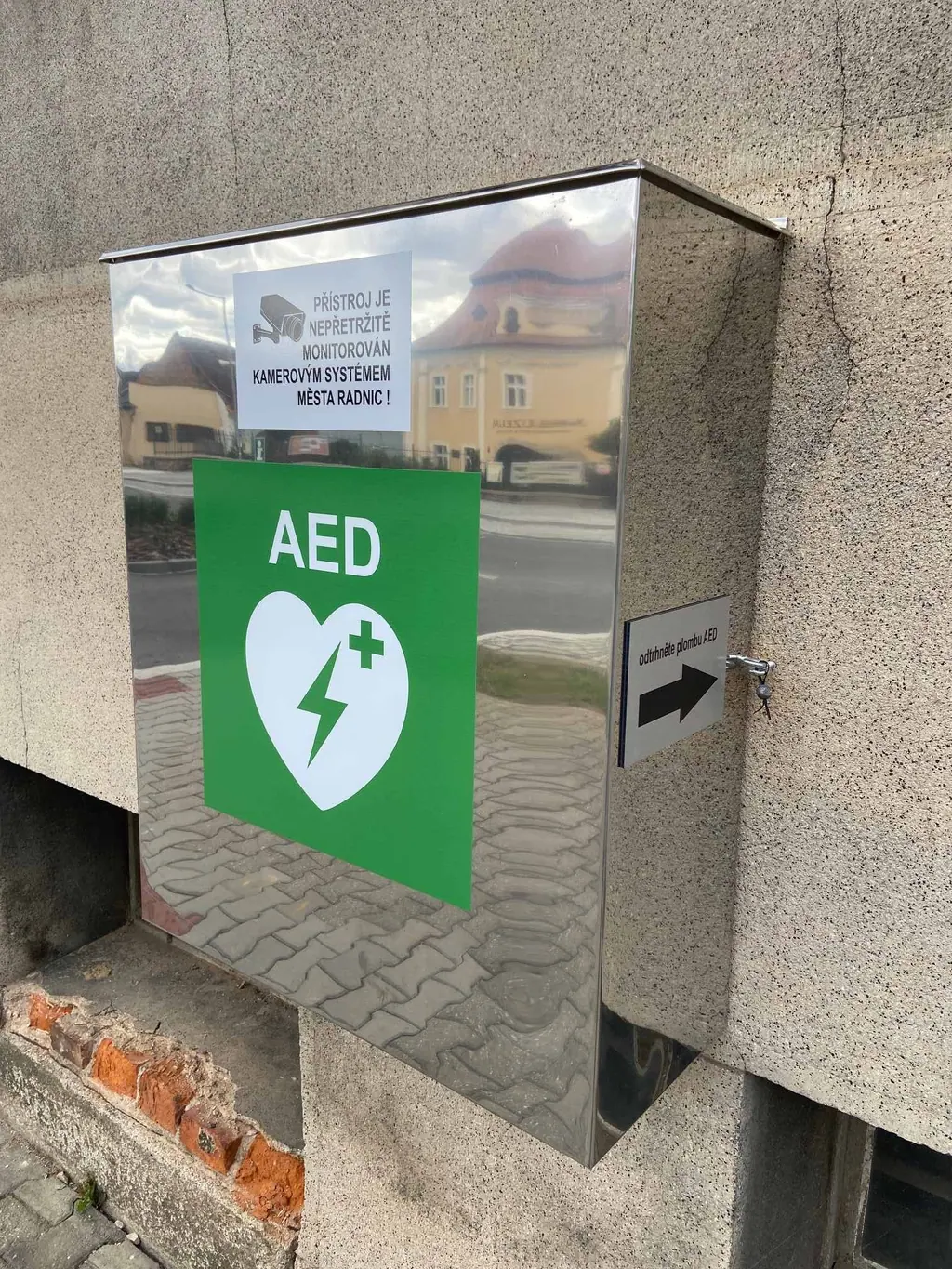
Town of Rokycany
OHS
Automated external defibrillators (AEDs) can significantly increase the chance of survival after sudden cardiac arrest if they are quickly available and used in time. By installing AEDs in public spaces, companies and sports facilities, we help create a safer environment where first aid is always within reach. Join us and let us take a step together towards protecting human lives.
An automated external defibrillator (AED) is a portable device that can restore normal heart activity during cardiac arrest by delivering an electric shock. Placing AEDs in public places and organisations increases the chance of saving a life, because it allows immediate first aid before the paramedics arrive.
Miroslav Dolanský, head of Rescue Group, says:
“An AED significantly increases the chance of survival in the event of sudden cardiac arrest. AEDs have already saved many lives. An external defibrillator works with any cardiac emergency. You just open it and follow the voice instructions. The device itself assesses whether a shock is needed or whether chest compressions should be performed.”
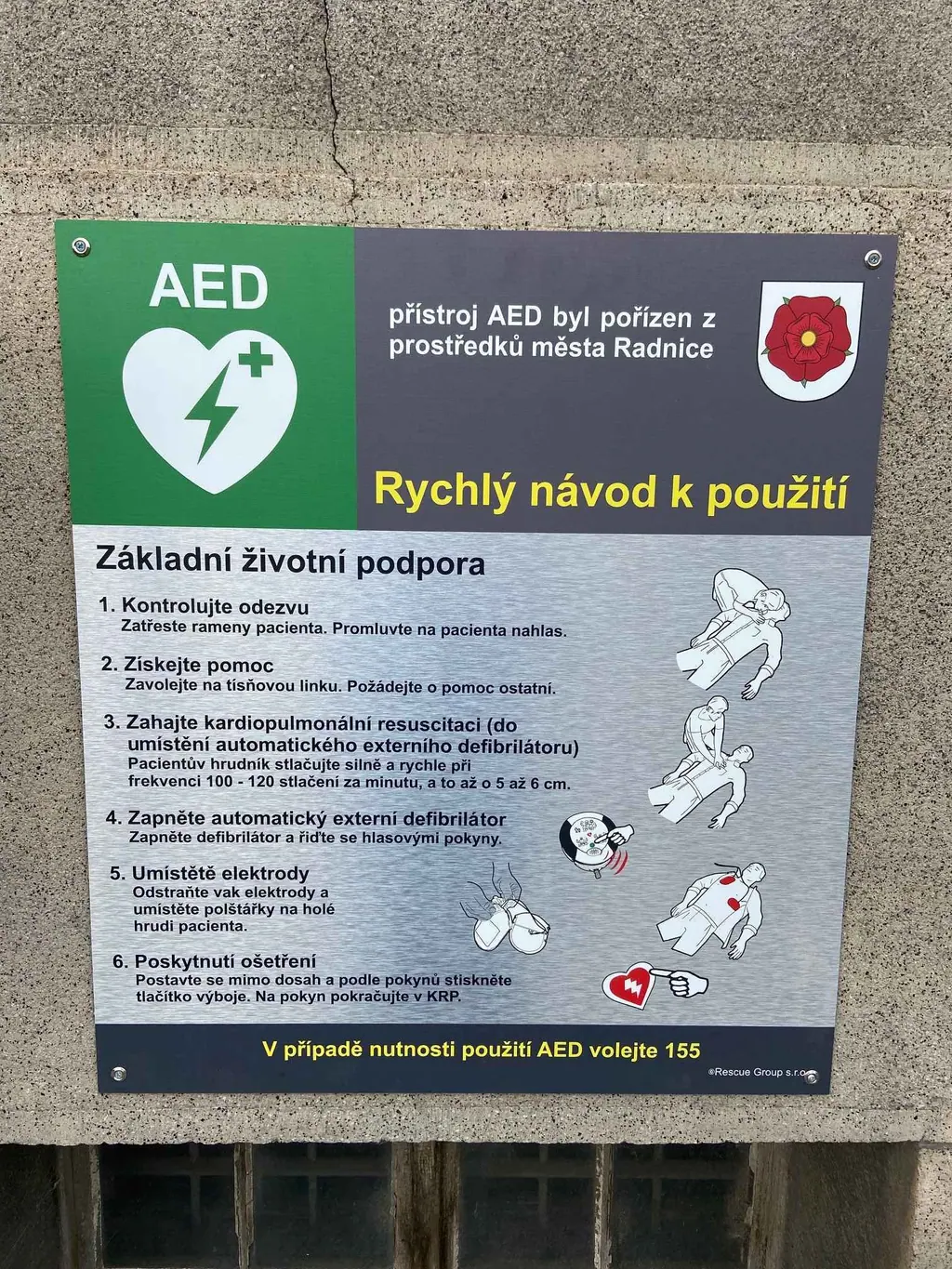
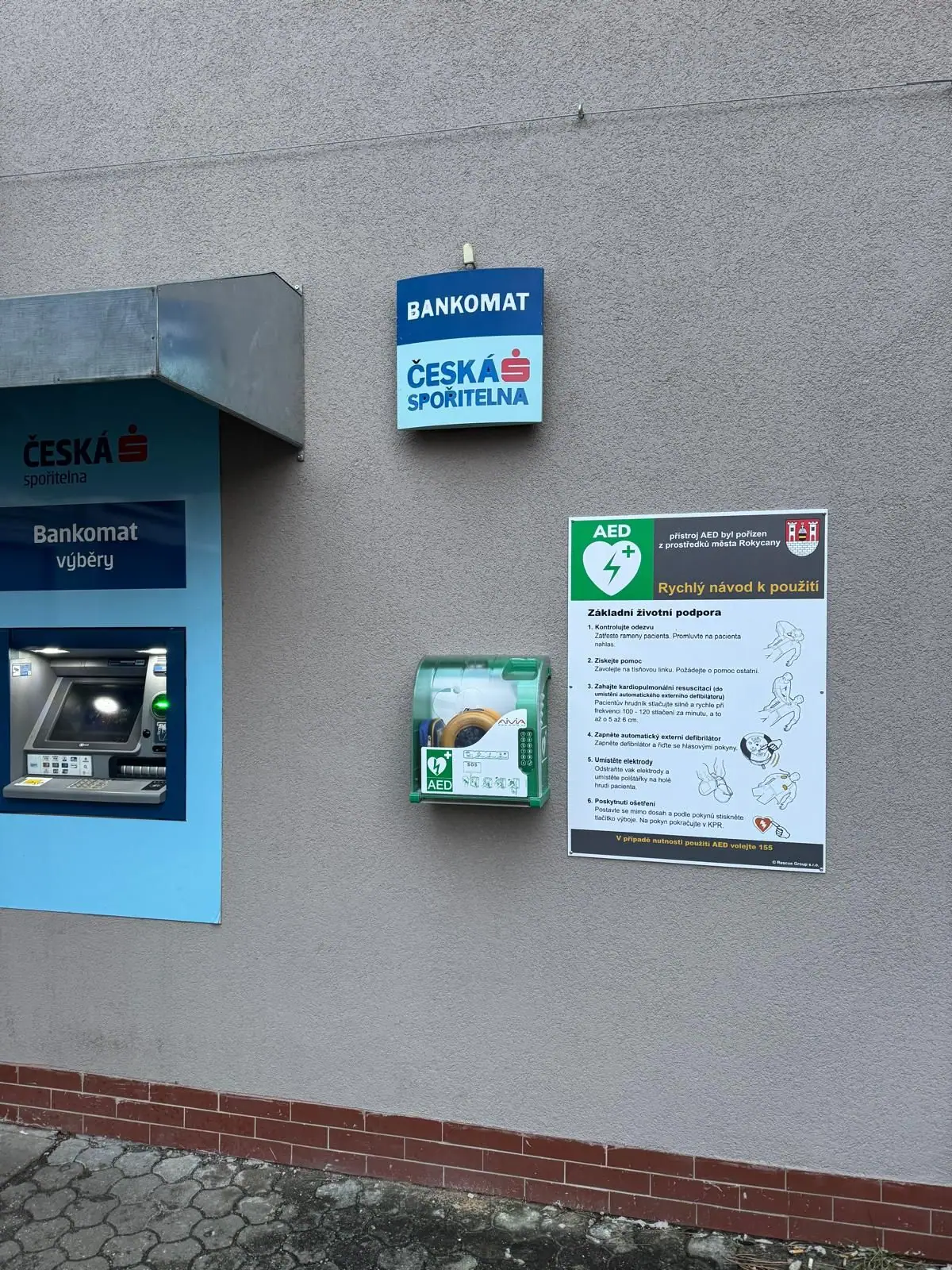
If cardiac arrest is suspected, the first step is to check vital signs. Every AED comes with an information sign with detailed instructions guiding the rescuer on what to do. Users learn how to find out whether the casualty is breathing and responding to stimuli, and how to call the emergency services correctly.
Once switched on, the AED gives voice instructions to the rescuer step by step. You simply attach the electrodes to the bare skin of the casualty’s chest as shown in the instructions. The device then automatically analyses the heart rhythm and decides whether an electric shock is needed. If so, it tells you to deliver the shock. If not, it guides the rescuer to start first aid in the form of cardiopulmonary resuscitation (CPR), i.e. alternating chest compressions and rescue breaths.
The great advantage of an AED is that it gives clear voice instructions throughout, telling you exactly what to do. This means that even a layperson can use it without any prior training – just follow the instructions and act, because every second can make the difference between life and death.
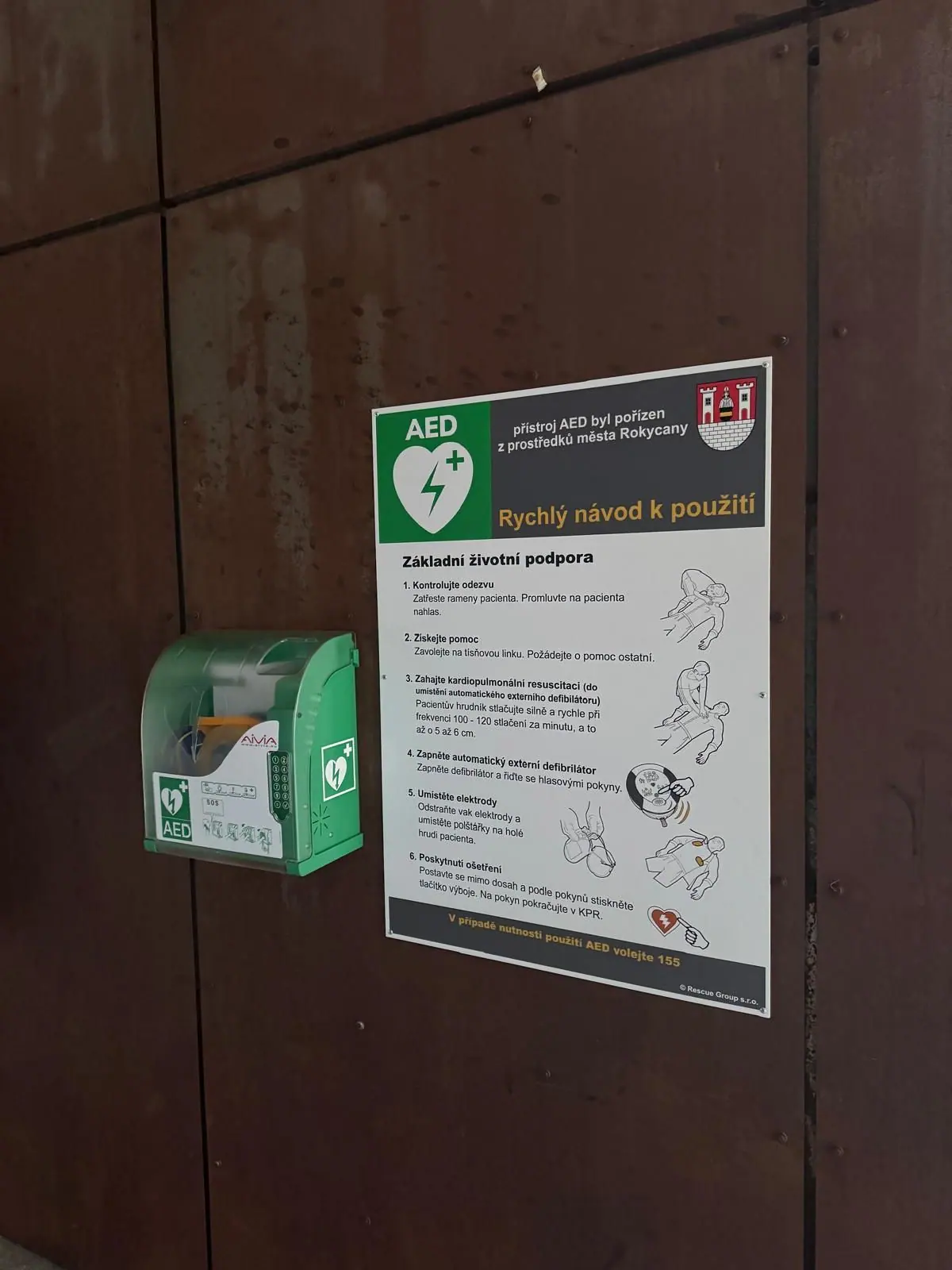
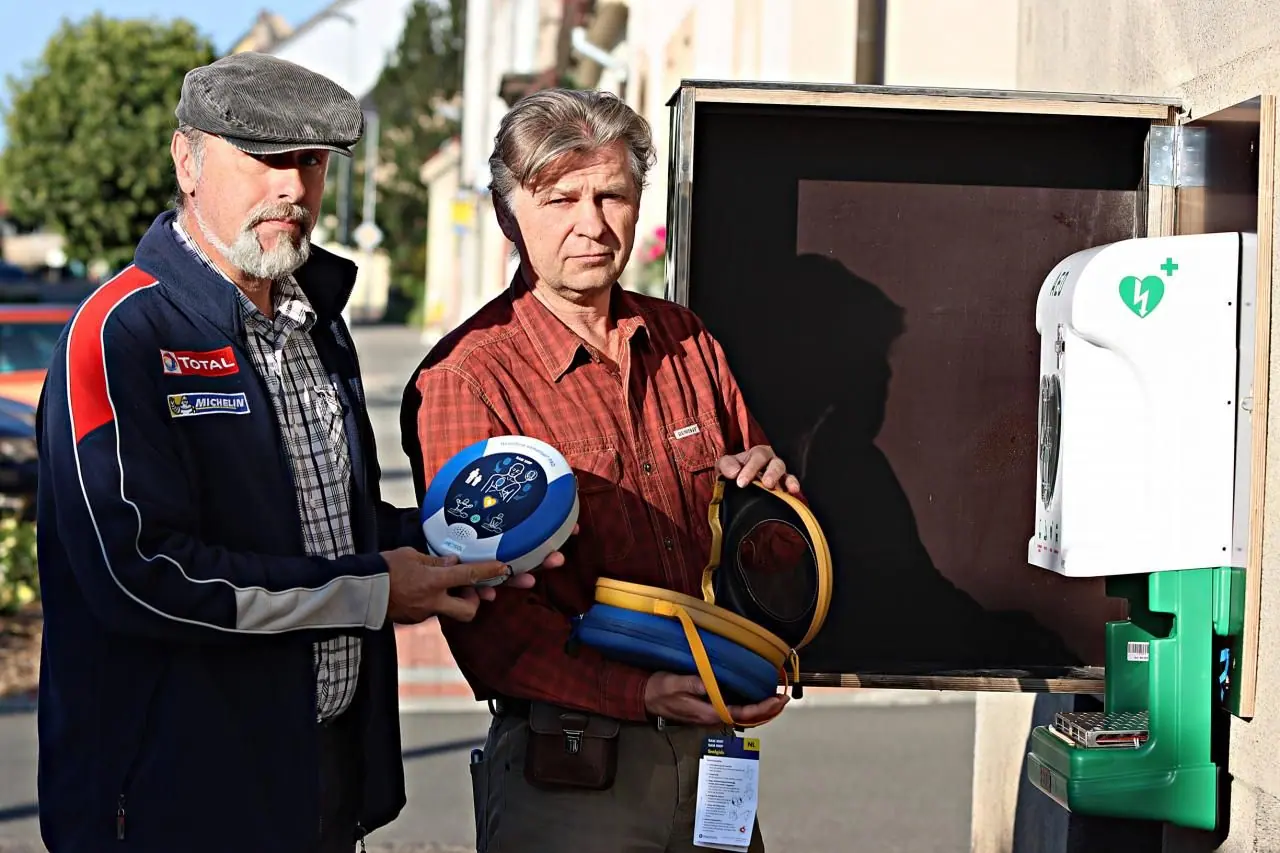
As part of our services, we have had the honour of installing AEDs in several towns. Our largest projects include the installation of two AEDs in the town of Rokycany and an installation in the town of Radnice. We are glad that our work helps increase the safety of people in the Pilsen Region, and we look forward to further projects. If you are interested, we will be happy to advise you and carry out the installation itself. We also install defibrillators in companies and sports facilities as part of safety and prevention.
Town of Rokycany
Town of Radnice
Cardiac arrest can strike anyone, at any time. In the Czech Republic there are more than 8,000 such cases every year. Without fast intervention, the chance of survival falls with every minute. An AED defibrillator – an automated external defibrillator – changes the rules of the game. It is a portable device that restores the heart rhythm with an electric shock. At Rescue Group we will help you install AEDs in companies, public spaces and sports facilities. We offer comprehensive services that make people safer.
An AED is a portable device designed for the immediate treatment of sudden cardiac arrest. It is designed so that even laypeople can use it. Once switched on, it gives clear voice instructions (in Czech for devices installed in the Czech Republic). First it asks you to check breathing. Then it tells you to attach the self-adhesive electrodes to the chest. Within a few seconds it analyses the heart rhythm itself and decides whether an electric shock is needed. Semi-automatic models ask you to press a button; with fully automatic models the shock is delivered on its own. If a shock is not indicated, the device immediately guides you to continue CPR (alternating chest compressions and rescue breaths).
Modern AEDs practically rule out an incorrect shock – they only deliver a shock when it is really needed. According to the European Resuscitation Council and the American Heart Association, the chance of survival falls by 7–10% for every minute without intervention. When an AED is used within 3–5 minutes of collapse, survival reaches 50–75%. In the Czech Republic, the chance of survival in places with an AED has increased significantly in recent years thanks to the growing number of publicly accessible defibrillators.
There are two basic types of AED on the market:
Both types can be used on adults and children – you simply switch to paediatric mode or attach children’s electrodes.
At Rescue Group we supply fully automatic AEDs certified by leading global manufacturers. Every model meets the applicable European standards and is registered as a medical device.
Installing an AED is a sign of responsibility and prevention. It is not a legal obligation, but a clear signal that you care about the health of your employees, clients and visitors. In the workplace or in public spaces it significantly increases the chance of survival in sudden cardiac arrest.
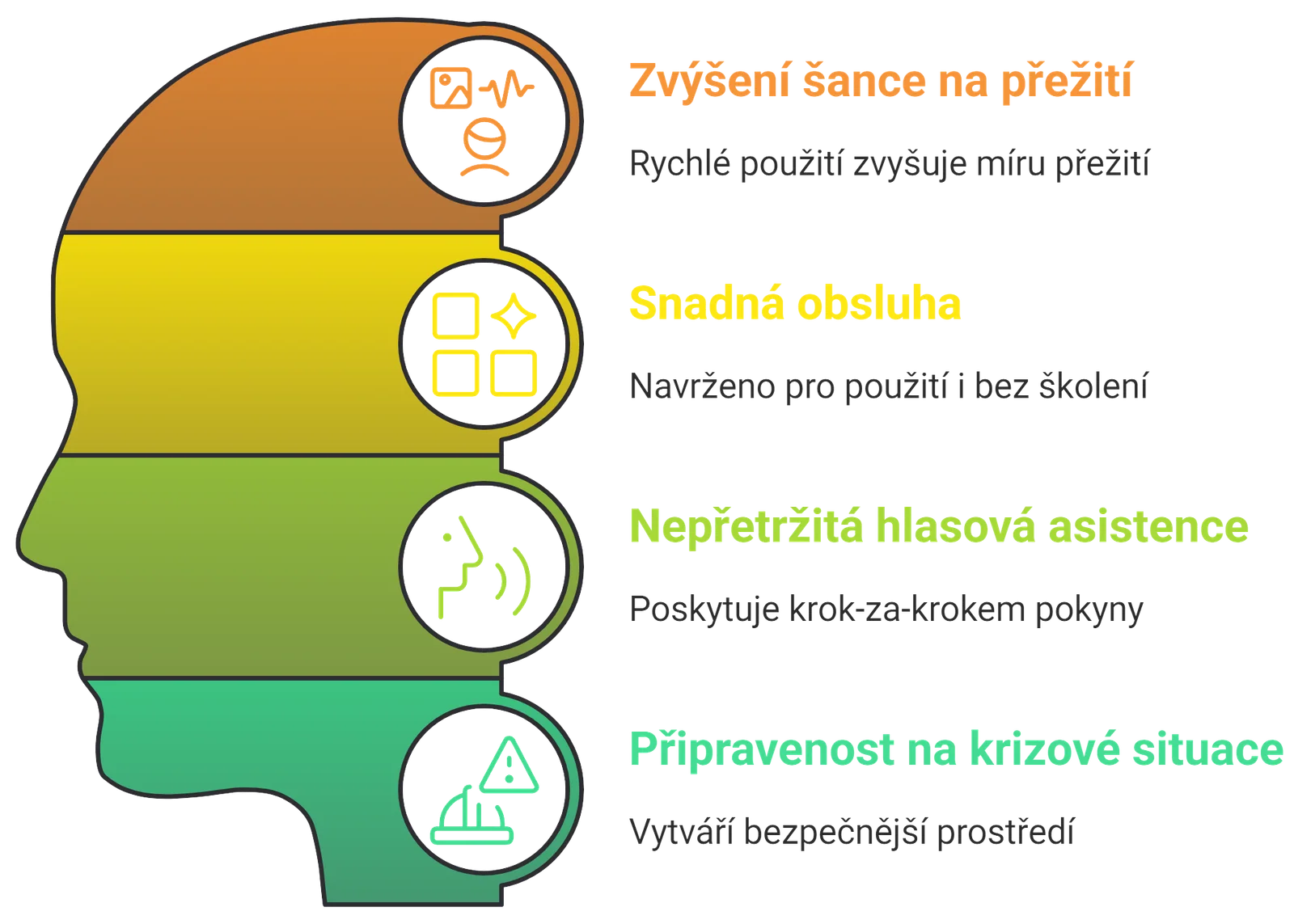
The main benefits include:
That is why more and more companies, sports facilities, schools and town halls choose professional AED installation from us. It is an investment that pays off in the most valuable thing of all – human lives.
Using an AED requires no medical education or special expertise. The device guides you with voice instructions from switching it on to the very last step. In an emergency, anyone can intervene, even someone who has never had any training.
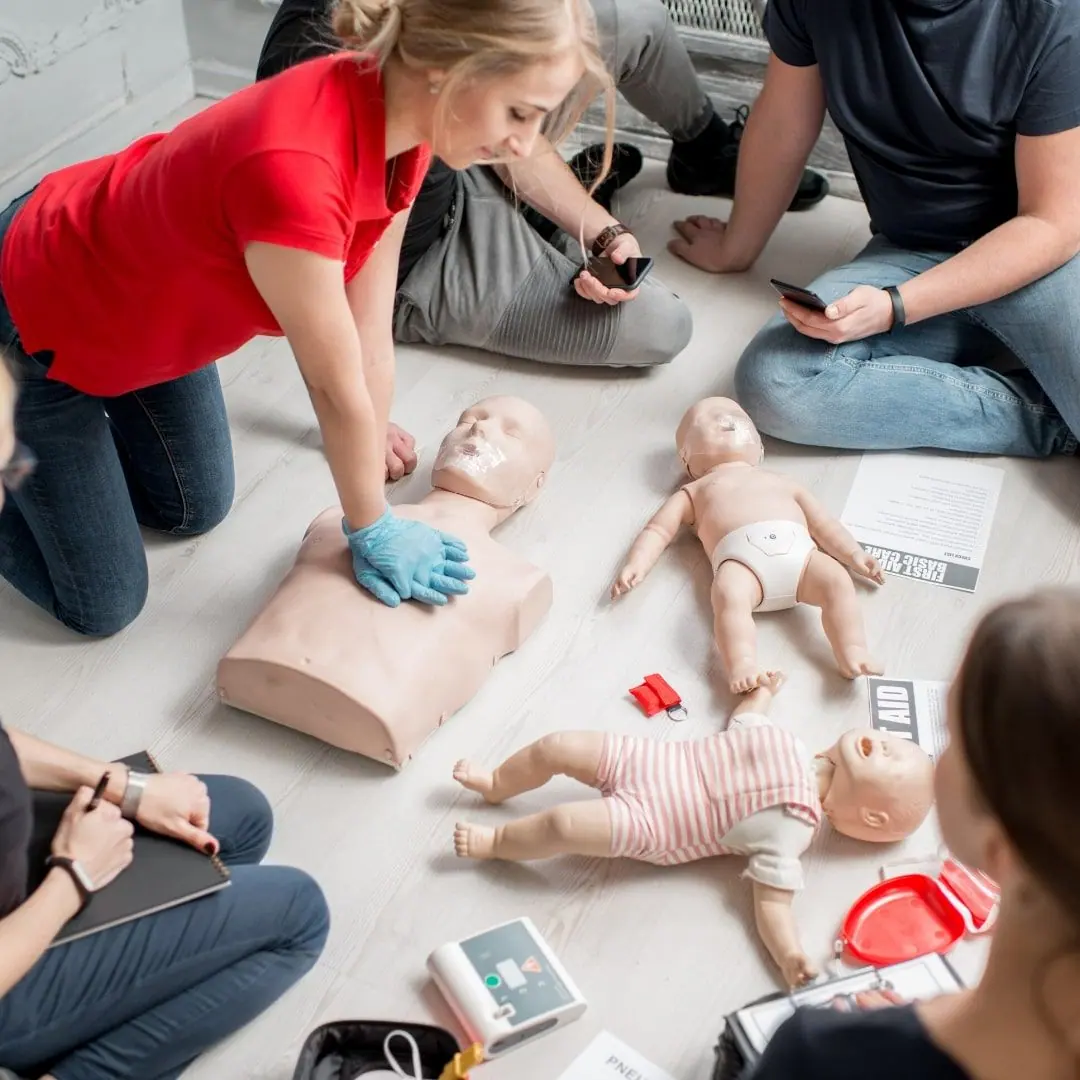
Even so, we recommend taking a short first aid training course. It will give you the confidence and calm not to hesitate for a second in a real situation. You will learn to recognise life-threatening conditions correctly – from cardiac arrest and choking to heavy bleeding. You will learn how to call the emergency number immediately, give chest compressions, stabilise the casualty and stop massive bleeding. You will practise everything on modern mannequins in a calm environment under the guidance of experienced trainers.
No. A modern AED analyses the heart rhythm and only delivers a shock when it is really needed. If the heart is beating normally, the device will never deliver a shock – so it is completely safe.
It is not mandatory, but we strongly recommend it. After installation we will be happy to register it on the national AED map. Paramedics will then know immediately that there is a defibrillator near you and can direct you to it.
It carries out an automatic self-test every day. If it detects a problem, it starts flashing red and beeping. If we install it, you get our non-stop line – we will come immediately and replace or repair the device.
Yes, in a special secure cabinet. The cabinet can be locked or left permanently open. The device is resistant to rain, frost and vandalism and works even at sub-zero temperatures.
Straight away. Once installed, the device is fully ready for immediate use. No further permission or waiting is needed.
An AED is more than a technical device. It is a sign of responsibility towards the people who move around your premises every day. It increases the chance of survival in sudden cardiac arrest from a few per cent to tens of per cent and gives everyone around the certainty that at a critical moment, no one is left without help.
By working with Rescue Group you get a comprehensive solution that works in the long term without unnecessary worries. You get a proven device from top manufacturers, a carefully planned location, regular care and a team of people who are ready to help whenever you need them. It gives you a clear conscience that you have done everything you can for your people’s safety – and that it really works.
Would you like an AED in your municipality or organisation?
Contact usWould you like an AED in your municipality or organisation?
We will be happy to provide a complete installation of an automated external defibrillator, including signage and an instruction sign. We will advise you on the most effective location. As part of our comprehensive services, we also offer first aid training for employees and the public. We are your partner for health and safety and fire protection. If you are interested in our services, do not hesitate to get in touch – we look forward to working with you.
OHS in your city: PilsenNýřanyRokycanyKlatovyDomažliceTachovKarlovy VaryChebSokolovPragueKladnoBerounPříbramMladá BoleslavKolínKralupy nad VltavouÚstí nad LabemMostChomutovŽatecTepliceČeské BudějoviceČeský KrumlovJindřichův HradecJihlavaPardubiceBrnoZábřeh
Find out what an AED defibrillator is, why it can save a life and where to place it for maximum effect in a company, a school or a public space.
Get in touch – we will discuss what your company really needs, with no obligation.